

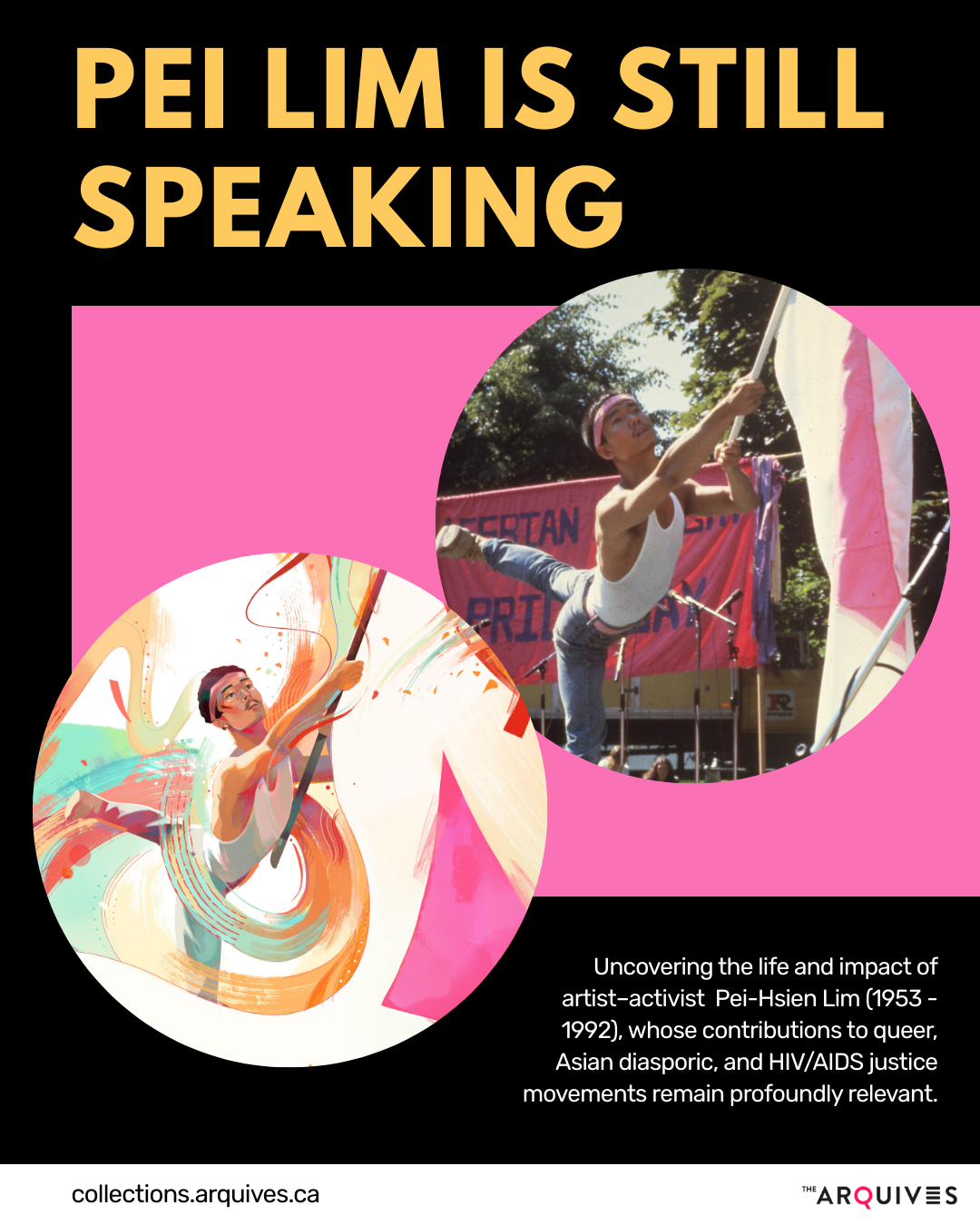
Cultural studies scholar David K. Seitz traces his decade-long, evolving research into the life and legacy of multidisciplinary artist and activist Pei-Hsien Lim.
Since 2014, I have been studying the astonishingly wide-ranging legacy of Pei-Hsien Lim (1953-1992), a multidisciplinary artist and activist born in Malaysia who made significant, underappreciated contributions to struggles against homophobia, racism, and HIV/AIDS in Toronto, Vancouver, and San Francisco.
But to say “I have been studying” might suggest a continuous, steady research process. Working on Lim – who lived in many places, touched many lives, and worked in many media, but did not leave his collected materials to a single institution or person – has been anything but continuous or steady.
This project began with a simple enough curiosity about “Never Again,” Lim’s stunning, defiant dance performance with a pink triangle flag at the end of the documentary film Track Two: Enough is Enough (1982). Track Two offers one of the most comprehensive accounts of the 1981 Bathhouse Raids and their politicizing effect on Toronto’s queer and allied communities. Solidarity against police brutality across the lines of race, gender, and sexuality is a central theme in Track Two, and Lim is easily the film’s most visible Asian Canadian subject, with his choreography of rebellion and pride both providing a moving conclusion and serving as the image for the film’s promotional poster. As a scholar of race, citizenship, and sexuality in urban social movements, it intrigued me that little over a decade after Canada liberalized its immigration and sodomy laws, a queer immigrant of colour could be the literal poster boy for a transformative film about queer rights.
I then learned that Lim had also appeared in numerous films by the internationally acclaimed Chinese Trinidadian Canadian filmmaker Richard Fung. Across Fung’s films, including Orientations: Lesbian and Gay Asians (1984), Chinese Characters (1986), and Fighting Chance (1990), Lim’s incisive, sophisticated critique of racial discrimination in gay men’s institutions and sexual cultures was ahead of his own time and, in many ways, remains ahead of our own.
But by 2019, I had published a couple of academic articles considering Lim’s appearances in Fung’s work – perhaps the first articles to make Lim a focus of academic inquiry in his own right – and I thought that was it. I had seen just about every publicly circulating print and film source on Lim, and I wanted to leave further analysis of his work to others.
Then in May 2021, I received an email from Rick Waines, a playwright and HIV-positive hemophiliac activist based in Victoria who befriended Lim when they overlapped at the Vancouver People with AIDS Society in the early 1990s. Waines appreciated my work, but yearned for a more public tribute to Lim’s memory. Waines’s play In My Day, a work of verbatim drama based on over 100 oral history interviews gathered by University of Victoria researchers with caregivers and survivors of the early years of the HIV pandemic in British Columbia, includes references to Lim. It debuted in Vancouver in 2022 and is in talks to be performed in Toronto in the next two years.
Meeting Waines and attending the premiere of In My Day, where there was not a dry eye in the house, compelled me to keep working on Lim, no longer limiting myself to sources in public circulation. Since 2023, I have repeatedly turned to The ArQuives, as well as to crucial sources in British Columbia and to Lim’s surviving comrades and loved ones, to learn even more about him. The support of The ArQuives – particularly reference archivist Daniel Payne – has been crucial in the creation of an exhibition for OutHistory published in March.
I am now working with my frequent collaborator Eve Oishi, a scholar of gender and sexuality in Asian North American media, to develop an edited volume of Lim’s writings, including responses from contemporary scholars in Asian North American studies, queer studies, and HIV/AIDS humanities.
If I’ve learned any one thing from Lim, it’s that we as researchers don’t decide when we’re “done” studying historical figures. Historical figures – and the loved ones and institutions that carefully steward their legacies – decide whether they’re done with us. Fortunately for us all, Lim still has a lot more to say, and I am committed to supporting efforts to reconnect Lim’s work with the many communities that claimed him.
Author Bio: David K. Seitz (he/him) is an associate professor of cultural studies at Harvey Mudd College in Claremont, California, U.S.A. He is the author of two books. A House of Prayer for All People: Contesting Citizenship in a Queer Church is an ethnographic study of the politics of race and citizenship at the Metropolitan Community Church of Toronto. A Different ‘Trek’: Radical Geographies of ‘Deep Space Nine’ is the first academic monograph to analyze the radical politics of Star Trek’s fourth television installment.