


The 1980s and 1990s were a rich period of creation and community for queer women of colour in and around Toronto. For these women creative expression went hand in hand with political activism, and while the collectives and communities emerging in the city at this time fostered a spirit of radical creativity and collaboration that has had a lasting effect on Canada’s cultural and political landscape.

Cover of the Women of Colour issue of “Fireweed: A Feminist Quarterly” 16, Spring 1983. Designed by Stephanie Martin. Source: The ArQuives Collections.
One of the earliest groups to platform the work of queer women of colour in the city was the Fireweed Collective, a feminist organization that began publishing a quarterly journal starting in the late 1970s. By the early 1980s, managing editors Makeda Silvera and Nila Gupta proposed the development of an issue devoted to the work of women of colour, only to be met with resistance from a board “hesitant to let women of colour have full editorial control” (Hassan). When the collective changed their tune two years later, Silvera and Gupta questioned their motivations, finding the invitation to be tokenistic and “racist in fact if not in intent” (Silvera and Gupta 5). Nevertheless, they forged ahead and in the spring of 1983 published an influential special issue edited entirely by feminists of colour, including poet Dionne Brand, political organizer Prabha Khosala, and writer Himani Bannerji. In addition to addressing the “structural gaps shaping the feminist movement” head-on (Hassan), the issue featured works by a wide variety of contributors, offering a rich cross-section of diverse cultural experience and creative forms. Transcending its contentious origins, Fireweed’s Women of Colour issue is now widely regarded as a significant “historical archive [of] Black and transnational feminist writing in Canada” (Hassan).
In addition to her work with the Fireweed Collective, Silvera was instrumental in the establishment of Sister Vision Press, the first publishing house in Canada dedicated to promoting the work of Black women and women of colour (CWHN). Founded in 1985 by Silvera and her partner Stephanie Martin in the basement of 101 Dewson House (a hub for many queer organizations at the time), Sister Vision Press challenged literary aesthetic norms, celebrating cultural and linguistic diversity while creating space for the “history of women often omitted from traditional history and contemporary writing” (CWHN). At its core, Sister Vision Press was a deeply collaborative organization, fueled by the belief that women of colour of all backgrounds should band together “in a spirit of sisterhood and respect to struggle against the prejudices and power imbalances that exist in society” (“About Us”). Before closing its doors in 2001, the small but mighty publishing house distributed more than 50 works by “Caribbean, Asian, First Nations, African, and mixed-race women,” many of them groundbreaking, award-winning publications that may never have otherwise seen the light of day (“Sister Vision Press”).

Book covers for Sister Vision Press publications Piece of My Heart: A Lesbian of Colour Anthology and Quilting a New Canon: Stitching Women’s Words. Source: The ArQuives Collections.
Some of the creators involved in these burgeoning literary communities expanded their creative efforts into the realm of filmmaking, with several taking advantage of the shifting climate at the National Film Board of Canada (NFB) to create projects reflecting their lived realities. When Studio D (the film board’s feminist film production unit) came under fire for its lack of diversity and inclusion in the late 1980s, new head Rina Fraticelli launched a series of initiatives designed to recruit “filmmakers from outside the [studio’s] majority white middle class culture,” making room for the more experimental and inclusive work of feminist filmmakers like Michelle Mohabeer and Dionne Brand (Anderson 48-49). Brand, already an accomplished author, made several documentaries under this umbrella, including Sisters in the Struggle (1991), which examined the activist work of various groups of women of colour in Toronto, and Long Time Comin’ (1991), spotlighting the work of African Canadian lesbian artists Faith Nolan and Grace Channer.
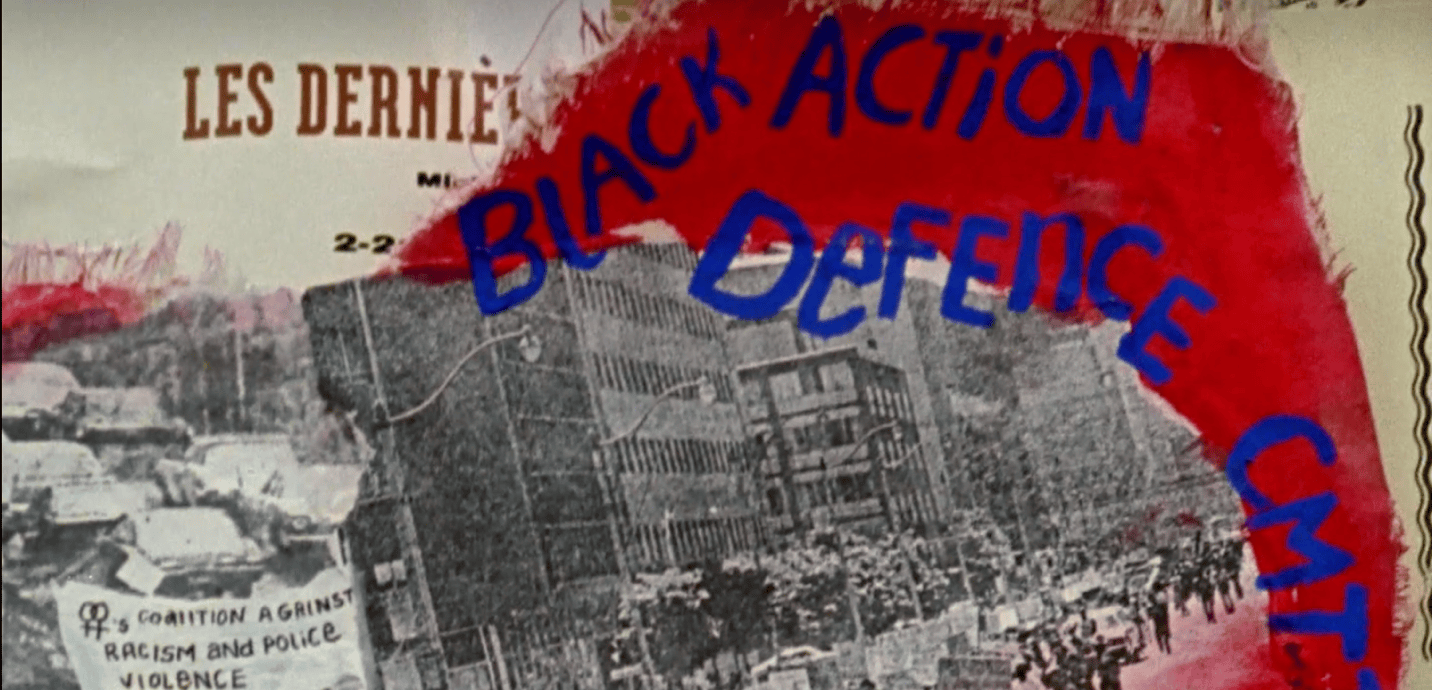
Toronto protests against racism and police violence. Source: Screenshot from Sisters in the Struggle
Alongside these activist writers and filmmakers, the city was home to a diverse and rapidly growing community of musicians, visual artists, and performers, showcased through public events organized by groups like Multicultural Women in Concert. Founded by Faith Nolan in 1983, MWIC aimed to uplift the liberatory creative work of women of colour, and serves as a prime example of the intertwined nature of creative and political endeavour characteristic of this era. Pushing beyond the borders of the city, in 1994, the group expanded its efforts with the establishment of Camp SIS (Sisters in Struggle) on a large piece of property north of Toronto. Run entirely by volunteers, Camp SIS continues to operate today, hosting creative workshops and retreats for women creators of colour. Over the past forty years, MWIC has demonstrated their tireless dedication to community building through its organization and promotion of film screenings “by queer and trans black women,” live performances showcasing “local womyn artists” (ArQuives Catalogue), extensive fundraising efforts, and much more.
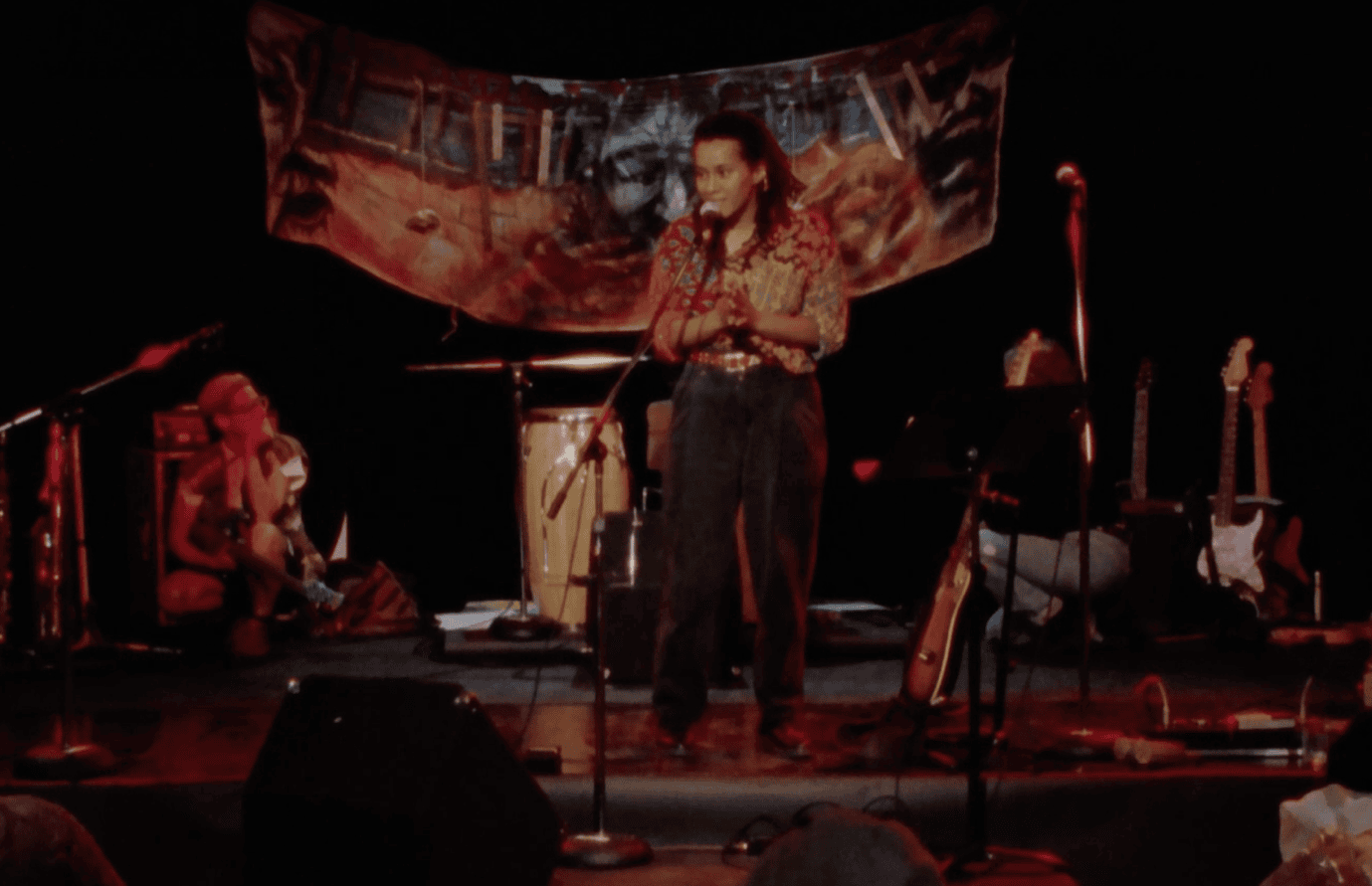
Faith Nolan performs at a fundraising event for Camp SIS. Source: Screenshot from Long Time Comin’
While it is impossible to provide an exhaustive accounting of groups doing important liberatory work in Toronto at this time, this brief overview starts to give us a sense of the deep spirit of collaboration and creativity they shared. The central figures in these movements expressed themselves politically and artistically across many platforms and disciplines, and supported one another in all of their endeavours. Together, they built an enduring legacy and blazed an exciting path for future generations of artists and activists in Canada and beyond.
Citations
“About Us.” Abeng: A Quarterly Newsletter of Sister Vision Press 1.1 (1990).
Anderson, Elizabeth. “Studio D’s Imagined Community: From Development (1974) to Realignment (1986-
1990). Gendering The Nation: Canadian Women’s Cinema. University of Toronto Press, 1999.
Birch-Bayley, Nicole, and Faith Nolan. ““A Vision Outside the System”: A Conversation with Faith Nolan
about Social Activism and Black Music in Contemporary Canada.” Postcolonial Text 6.3 (2011): 1-15.
Brand, Dionne. Long Time Comin’. National Film Board of Canada. 1991.
Brand, Dionne. Sisters in the Struggle. National Film Board of Canada. 1991.
“Dionne Brand.” Wikipedia, https://en.wikipedia.org/wiki/Dionne_Brand.
“Faith Nolan.” Wikipedia, https://en.wikipedia.org/wiki/Faith_Nolan.
Hassan, Huda. “Fireweed’s Revolutionary Women of Colour Issue Lit a Path for Feminist Publishing 40
Years Ago.” CBC. 5 June 2023. https://www.cbc.ca/arts/fireweed-women-of-colour-issue-40-year-anniversary-1.6866028.
Silvera, Makeda. “’Grand Central Station for Toronto’s Queers of Colour’: The Inside History of Dewson
House.” CBC. 5 October 2021. https://www.cbc.ca/arts/grand-central-station-for-toronto-s-queers-of-colour-the-inside-history-of-dewson-house-1.6184304.
Silvera, Makeda and Nila Gupta. “We Were Never Lost.” Fireweed: A Feminist Quarterly. 16 (1983): 5-7.
“Sister Vision Educational Press.” Canadian Women’s Health Network.
https://web.archive.org/web/20180420075045/http://www.cwhn.ca/en/node/18015.
“Sister Vision Press.” Rise Up! Feminist Digital Archive.
https://web.archive.org/web/20190220181439/https://riseupfeministarchive.ca/activism/organizations/sister-vision-press/.
South Asian Visual Arts Centre (SAVAC). “Oral History Interview with Michelle Mohabeer.” The ArQuives
Digital Exhibitions, https://digitalexhibitions.arquives.ca/items/show/823.
Author bio: Ester Bovard is an archival film scholar and writer based in Toronto. A graduate of the MA programme in Preservation & Presentation of the Moving Image at the University of Amsterdam, she has collaborated on projects with Arsenal Institute for Film and Video Art, UMAM Documentation & Research, and the Netherlands Institute for Sound & Vision.