

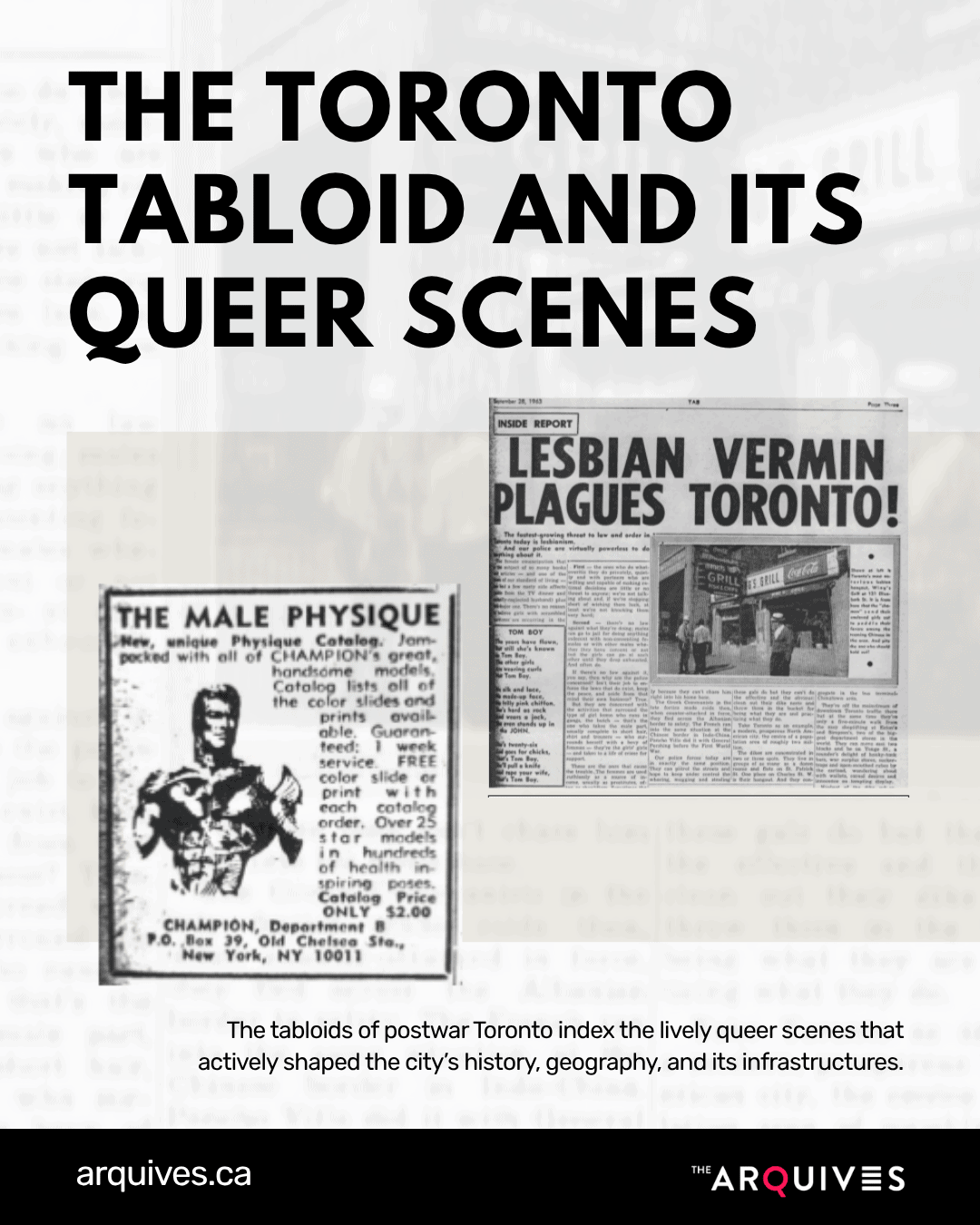
Kathryn Gamboa shares how the tabloids of postwar Toronto index the lively queer scenes that actively shaped the city’s history, geography, and its infrastructures.
Toronto became the “tabloid capital of Canada” during the interwar period with its “established network of newsboys and newsstands” and a well-connected transportation network that served all areas of the country.1 From 1940 to 1946, a golden era of Canadian English-language tabloids and lowbrow periodicals emerged following the Canadian government’s 1940 ban on “certain classes of commodities” imported from the United States deemed non-essential in an attempt to stimulate the economy.2 Though the ban was lifted by the end of the Second World War, the popularity of tabloids was well established and continued to be an integral part of daily periodical culture.3
While tabloids thrived on sensationalism, often referred to as ‘scandal sheets’ or ‘the gutter press’, they were small independent presses that paired scandal with “populist crusades against a litany of injustices – real or imagined.”4 Tabloids prided themselves on publishing stories that mainstream presses thought were too salacious for the public. Homosexuality and queerness became a focal point for the tabloids, producing, as Christine A. Sismondo argues, “competing discourses” from both inside and outside the queer community.5
The 1950s and 60s in Canada saw an accumulation of the criminalization and vilification of queerness. In 1910, Ontario legislation required psychiatric evaluations for men charged with homosexuality and, in 1917, the broadening of bawdy house laws implicitly targeted the sexual activity of gay men.6 These legislative practices were compounded by the postwar ‘lavender scare’ in which Cold War sentiments were mapped onto the public’s growing awareness of queer life in the city. Toronto’s major tabloids – Hush (1927-1973), Flash (1938-1973), Justice Weekly (1946-1970s), True New Times (est. 1950), Rocket (est. 1951), Tab (1956-c.1970s) – utilized the public’s apprehension of queerness as one of many attempts to retain readership by accentuating controversy and scandal amid American tabloids’ successful turn to celebrity gossip as the Hollywood studios’ star system began declining in the 1950s.8
Tabloids reported on news stories from local court proceedings skewing the lens of the public’s exposure to homosexuality and queerness towards the “mundane cases that were usually kept hidden within families, churches, schools, and the local sex trade.”9 The ArQuives’ LGBTQ+ Tabloid Newspapers digital exhibition traces the fabrication of homosexuality, transness, and drag within the Canadian legal system and its association with illness, criminality, and sexual deviance as something rapidly encroaching into the public sphere from the degenerate margins of society. While making glimpses of queer life publicly known, tabloids did little to resist the hegemonic cultural and legal discourses within which homosexuality and queerness was fraught.
Inflammatory accounts of the arrests of gay men for ‘gross indecency’ made up a large section of the tabloids’ scandal sheets, framing the articles with headlines like: “City cops nab pair of sordid sex perverts! ‘Was drunk’ is plea but court fines duo!”10 In such reports, sex between two men, whether in public or private spaces, were described as “performing disgusting perversion”11 or “un-natural lovemaking.”12
Accounts of butch lesbians, constructed as the “girl homo who runs in gangs…complete to short hair and trousers,” and femme lesbians, as the “source of income, usually as prostitutes, often shoplifters,” established a dichotomy through which tabloids construed lesbians as transgressors against the public.13 Tabloids used these classifications in reports of police arrests of lesbians working in bawdy houses to reinforce how lesbianism was, according to Tab in September 1963, “the fastest growing threat to law and order in Toronto today.”14
Cross-dressing, and any sense of gender non-conformity, presented categorical confusion about gender and sexuality in the tabloids. In May 1963, Justice Weekly writes that there are many “normal men” who cross-dress and because they “are not classed as homosexuals […] they can be cured” by new promising aversion therapies.15 In reports of court proceedings, tabloids fixated on the misalignments of public presentations: “If there was any doubt of the accused person’s sex it was dispelled on the second appearance in…court when he was dressed like a man.”16
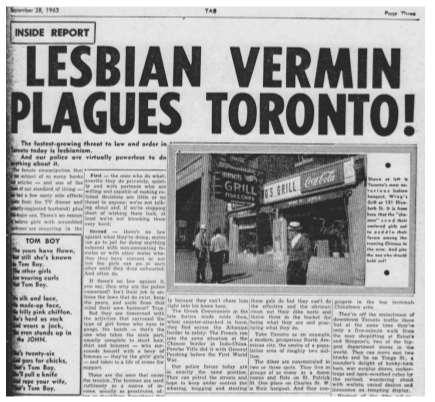
“Lesbian Vermin Plagues Toronto!” Tab, September 28, 1963. The ArQuives Digital Exhibition.
In the early 1950s, a wave of opposing columns penned by gay and lesbian citizens began to emerge as Toronto tabloids continued to generate scandal. Gay activist, Jim Egan, regularly contributed to Justice Weekly writing numerous articles responding to the tabloids’ homophobic exposés with rational arguments, even persuading Justice Weekly to occasionally re-print articles from homophile organizations in the United States like ONE Inc.17 Articles like these presented a corrective lens to tabloids’ sensationalism with “assimilationist arguments.”18 In a letter to the editor published in Flash, a contributor writes with admiration of Egan’s columns, agreeing with Egan that “it’s time that sensationalism and other colorful names…be wiped aside” adding that “not one in a hundred male prostitutes is a genuine homosexual.”19
Contributors like Egan argued that despite the ‘lascivious criminals’ found in the scandal sheets, there existed ‘normal’ gays and lesbians who kept their homosexual affairs to the confines of their homes. In a 1954 Justice Weekly re-print of a ONE Inc. article, a lesbian argues that it’s “the cause of the homosexual to prove that he or she is a decent citizen of good character.”20 Respectability politics provided an easy basis to argue for the same human rights afforded to heterosexuals but ultimately evaded the systemic nature of homophobia opting instead for individualistic gain.
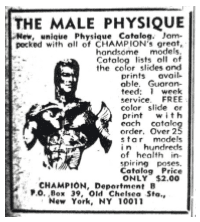
“The Male Physique.” Tab, December 14, 1963. The ArQuives Digital Exhibition.
Cutting across the scandal sheets and pleas for respectability are the gay gossip columns anonymously penned by Bettina of Tab’s ‘Fairy-Go-Round,’ Duke Gaylord of Tab’s ‘The Gay Set’ (successor of Bettina in the late 1960s), and Mother Goose of Hush Free Press’ ‘Fairy Tales Are Retold.’ These columns documented lesbian and gay bars and physical spaces “in a comical tone with little to no moral censure,” using camp language that only the gays and lesbians moving through these spaces were privy to establishing a “private communication that proliferated in sanctuary spaces—a lavender code.”21
Alongside these gay gossip columns were gay men’s classified ads that tabloids began publishing in the 1960s. These classifieds allowed gay men to join heterosexuals in publicizing their own proposals for sexual exploration and romantic connection. Classifieds also created a material space for the exchange of information about gay meeting sites and pornography: Men of the Twilight Zone, “An interesting and informative booklet discussing the gay male” provided readers with “extremely interesting information on locations, etc.”
As David Churchill wrote in 2004, gay gossip columns established a geography of gay spaces from “city parks, bathhouses, bars, cinemas, and public washrooms,” functioning as a map of postwar Toronto where men could regularly visit to socialize and connect with another and sometimes have sex.22 Bars were highly stratified spaces mediated by race and class and remained sexually segregated until the early 1960s, concentrating lesbians to few public drinking options like the Continental Hotel drinking lounge.23 As lesbians frequented their limited options,24 and where gay men seldom had sex in bars, these public drinking spaces became a “fully developed articulated site” in which gays and lesbians socialized and partook in shared social activity.25
While the informative capacity of gay gossip columns was largely limited to those partaking in the Toronto queer bar scenes, these columns also documented and made public the annual Miss Letros drag ball held on Halloween at the Letros Tavern from the 1950s to the 1960s, the one night in the year where queerness was on full unabashed display and continued to attract the public’s attention through its eventual move to the St. Charles Tavern as Letros closed in 1972.26 The tabloids and its gay gossip columns mapped a queer geography of Toronto and, in doing so, allowed gays, lesbians, and queers to gather, socialize, and create their own communities within public spaces.
By 1969, a growth of queer journals and magazines appeared as the gay liberation movement emerged across North America.27 In Canada, The Body Politic was launched in November 1971 in Toronto following the We Demand march of August 1971 on Parliament Hill, a political action organized by Toronto Gay Action and Community Homophile Association of Toronto that demanded changes to legislation and public policy targeting gay and lesbian rights.28 The Body Politic was instrumental in continuing the political activity of the We Demand march as it provided a means to contest hegemonic discourses of homosexuality and queerness while documenting and celebrating queer culture, history, and resistance.
Where Jim Egan challenged the tabloids’ representations of homosexuality to establish respectability for gay and lesbian citizens, the collective behind The Body Politic grew out of the broader political organizing of the late 1960s—the feminist, Black Power, Indigenous rights, and the gay liberation movements—and sought discursive autonomy by establishing a queer press. Run predominantly by white cisgender gay men and several women until its end in 1982, The Body Politic has been criticized for neglecting the voices of their racialized peers.29 However, one might trace the push towards discursive autonomy for queer racialized women with the creation of Sister Vision Press in 1985, a publishing collective founded by writer Makeda Silvera and her partner, artist Stephanie Martin, dedicated to publishing and engaging the works and ideas of Black queer women.30
Postwar Toronto saw the cultivation of distinctly queer scenes from the economic and sexual practices of the sex trade, the camp discourses of gay gossip columns, and the social rituals and cruising practices formed within bars and other public spaces. These scenes capture the cultural forms and textures of sociability that “take shape…on the edges of cultural institutions,” which, themselves, “can only partially absorb and channel the clusters of expressive energy.”31 The competing discourses that developed from Toronto’s tabloids not only evidence the contradictory ways homosexuality and queerness was fashioned, but that the queer lives of postwar Toronto always exceeded the narratives that tried to represent them.
In documenting the margins of social and cultural life in the city, however salacious and contradictory, the tabloids of postwar Toronto index the lively queer scenes that actively shaped the city’s history, geography, and its infrastructures. Tracing a historical evolution from the postwar tabloid to the creation of a queer press and, later, to a publishing collective created for and by queer racialized women, a legacy of queer voices materializes from the margins of the scandal sheets to speaking on their own terms.
Author Bio: Kathryn Gamboa (she/her) is a Communications Committee Volunteer. She is completing a co-op as the Srivastava Endowment Intern at the University of Waterloo’s Special Collections and Archives. She is currently an MLIS candidate at the University of Western Ontario.
Consulted collections from The ArQuives
- Halloween Balls at the Letros and St. Charles Taverns – The ArQuives Digital Exhibition
- LGBTQ+ Tabloid Newspapers – The ArQuives Digital Exhibition
- Jim Egan: Canada’s First Public LGBTQ Activist – The ArQuives Digital Exhibition
- 1971 We Demand March – The ArQuives Digital Exhibition
References
- Huston, “‘A Little Steam, a Little Sizzle and a Little Sleaze’: English-Language Tabloids in the Interwar Period,” 38, 45.
- Straw, “Constructing the Canadian Lowbrow Magazine the Periodical as Media Object in the 1930s and 1940s,” 112-113.
- Straw, “Constructing the Canadian Lowbrow Magazine.”
- Huston, “‘A Little Steam, a Little Sizzle and a Little Sleaze’,” 40.
- Sismondo, “Toronto the Gay: The Formation of a Queer Counterpublic in Public Drinking Spaces,” 55.
- The Canadian Encyclopedia, “2SLGBTQ+ History.” For more on bawdy house laws and the Toronto bathhouse raids, see Jaime Bradburn’s entry “Toronto Bathhouse Raids (1981)” in The Canadian Encyclopedia.
- Sismondo, “Toronto the Gay,” 26.
- Shaw, “The People’s Papers: The rise and fall of the Canadian tabloid,” citing Will Straw.
- Jacques, “The Newspaperman and the Tabloid: Recovering the History of Philip H. Daniels and Justice Weekly,” 58.
- “City cops nab pair of sordid sex perverts! ‘Was drunk’ is plea but court fines duo!,” The ArQuives Digital Exhibitions. https://digitalexhibitions.arquives.ca/items/show/172.
- “Cinderola and the pansies,” The ArQuives Digital Exhibitions. https://digitalexhibitions.arquives.ca/items/show/169.
- “Socialite doctor found with pansy,” The ArQuives Digital Exhibitions. https://digitalexhibitions.arquives.ca/items/show/168.
- “Lesbian vermin plagues Toronto!,” The ArQuives Digital Exhibitions. https://digitalexhibitions.arquives.ca/items/show/221.
- “Lesbian vermin plagues Toronto!,” The ArQuives Digital Exhibitions.
- “Aversion therapy claimed cure for males dressing as females,” The ArQuives Digital Exhibitions. https://digitalexhibitions.arquives.ca/items/show/189.
- “Transvestite is guilty of gross indecency: enlists sympathy of court so sentence is suspended; other party is fined $100,” The ArQuives Digital Exhibitions, accessed March 9, 2026, https://digitalexhibitions.arquives.ca/items/show/188.
- Jacques, “The Newspaperman and the Tabloid.” Sismondo, “Toronto the Gay.”
- Sismondo, “Toronto the Gay,” 8.
- Percival Prosser, “Let’s be done with this confusion and sensationalism”,” The ArQuives Digital Exhibitions. https://digitalexhibitions.arquives.ca/items/show/302.
- “Lesbians not flamboyant,” The ArQuives Digital Exhibitions.
- Sismondo, “Toronto the Gay,” 57, 99.
- Churchill, “Mother Goose’s Map: Tabloid Geographies and Gay Male Experience in 1950s Toronto: Tabloid Geographies and Gay Male Experience in 1950s Toronto,” 829.
- Churchill, “Mother Goose’s Map.” Sismondo, “Toronto the Gay.”
- As Sismondo notes: “There are similarities between the class divisions in the men’s bars and the ones analyzed by Elise Chenier, largely at the Continental Hotel, which was almost the only public drinking option for lesbians in postwar Toronto until the early 1960s. Although there have been occasional mentions of additional venues—the Rose, the Turf Club Hotel, the Holiday Tavern and the Rideau Tavern—most alternatives to the Continental seem to have been short-lived and transitory, since they don’t appear in the literature very consistently. In addition, there are occasional mentions of queer women at the King Edward, [Bar] Letros and both the Municipal and Union House, even though Egan never includes mention of any women in either contemporary accounts or later memoirs. Since the Continental was the only public drinking space that was regularly and consistently patronized by lesbians in the 1950s, the class divide—or, between downtowners and uptowners, as Chenier clarified in the context of Toronto’s queer community—was played out in that one bar” (91).
- Churchill, “Mother Goose’s Map,” 848.
- “Halloween Balls at the Letros and St. Charles Taverns.” The ArQuives Digital Exhibitions. https://digitalexhibitions.arquives.ca/exhibits/show/halloween-letros stcharles/introduction.
- Some included San Francisco’s Gay Sunshine (August 1970), Detroit’s Gay Liberator (April 1970), and Boston’s Fag Rag (Summer 1971). Jackson & Persky, 1982.
- “1971 We Demand March.” The ArQuvies Digital Exhibition. https://digitalexhibitions.arquives.ca/exhibits/show/1971-we-demand-march/introduction.
- Mandy Byron, “Four Decades after The Body Politic: A Look at the Collective and Contributing Women.” The ArQuives, November 6, 2018. https://arquives.ca/four-decades-after-the-body-politic/.
- Stephenie Martin, “Makeda Silvera (1955 – ),” The ArQuives Digital Exhibitions. https://digitalexhibitions.arquives.ca/items/show/147.
- Straw, “Cultural Scenes,” 416.
Bibliography
The ArQuives. “Halloween Balls at the Letros and St. Charles Taverns.” The ArQuives Digital Exhibition. https://digitalexhibitions.arquives.ca/exhibits/show/halloween-letrosstcharles/introduction.
The ArQuives. “Jim Egan: Canada’s First Public LGBTQ Activist.” The ArQuives Digital Exhibition. https://digitalexhibitions.arquives.ca/exhibits/show/jim-egan/early-years.
The ArQuives. “LGBTQ+ Tabloid Newspapers.” The ArQuives Digital Exhibition. https://digitalexhibitions.arquives.ca/exhibits/show/tabloids.
The ArQuives. “1971 We Demand March.” The ArQuvies Digital Exhibition. https://digitalexhibitions.arquives.ca/exhibits/show/1971-we-demand-march/introduction.
Bébout, Rick. “On the Origin of The Body Politic.” rbebout.com. http://www.rbebout.com/oldbeep/beepint.htm.
Bovard, Ester. “Sisters in The Struggle: Creativity, Collectivity and Community.” The ArQuives, April 7, 2026. https://arquives.ca/sisters-in-the-struggle/.
Byron, Mandy. “Four Decades after The Body Politic: A Look at the Collective and Contributing Women.” The ArQuives, November 6, 2018. https://arquives.ca/four-decades-after-the-body-politic/.
The Canadian Encyclopedia. “2SLGBTQ+ History.” Date accessed February 5, 2026. https://www.thecanadianencyclopedia.ca/en/timeline/lgbtq2.
Churchill, David S. “Mother Goose’s Map: Tabloid Geographies and Gay Male Experience in 1950s Toronto: Tabloid Geographies and Gay Male Experience in 1950s Toronto.” Journal of Urban History 30, no. 6 (2004): 826-852. Doi: doi.org.10.1177/0096144204266743.
Houston, Susan E. “‘A Little Steam, a Little Sizzle and a Little sleaze’: English-Language Tabloids in the Interwar Period.” Papers of The Bibliographical Society of Canada 40, no. 1 (2002): 37-60. doi.org/10.33137/pbsc.v40i1.18251.
Jacques, Mary A. “The Newspaperman and the Tabloid: Recovering the History of Philip H. Daniels and Justice Weekly.” PhD diss., McGill University, 2014.
Levy, Ron. “The Body Politic.” The Canadian Encyclopedia, June 19, 2024. https://thecanadianencyclopedia.ca/en/article/the-body-politic.
Mann, Arshy. “What was The Body Politic, anyway?” Xtra Magazine, June 9, 2016. https://xtramagazine.com/power/what-was-the-body-politic-anyway-71206.
Martin, Stephanie. “Makeda Silvera (1955 – ).” The ArQuives Digital Exhibitions. https://digitalexhibitions.arquives.ca/items/show/147.
Richardson, Gordon. “What’s in the Archives? The Body Politic.” The ArQuives, April 17, 2013. https://arquives.ca/whats-archives-body-politic/.
Setliff, Eric. “Sex Fiends or Swish Kids?: Gay Men in Hush Free Press, 1946-1956.” In Gendered Pasts: Historical Essays in Femininity and Masculinity in Canada, edited by Nancy M. Forestell, Kathryn M. McPherson, and Cecilia Morgan. Oxford University Press, 1999.
Shaw, Robert. “The People’s Papers: The rise and fall of the Canadian tabloid.” Broken Pencil, July 26, 2011. https://brokenpencil.com/features/the-peoples-papers-the-rise-and-fall-of-the-canadian-tabloid/.
Sismondo, Christine A. “Toronto the Gay: The Formation of a Queer Counterpublic in Public Drinking Spaces, 1947-1981.” PhD diss., York University, 2017.
Straw, Will. “Constructing the Canadian Lowbrow Magazine the Periodical as Media Object in the 1930s and 1940s.” Journal of Modern Periodical Studies 6, no. 2 (2015): 112-133.
Straw, Will. “Cultural Scenes.” Loisir et société / Society and Leisure 27, no. 2 (2004a): 411-422.
Straw, Will. “Traffic in Scandal: The Story of Broadway Brevities.” University of Toronto Quarterly 73, no. 4 (2004b): 947-971.