

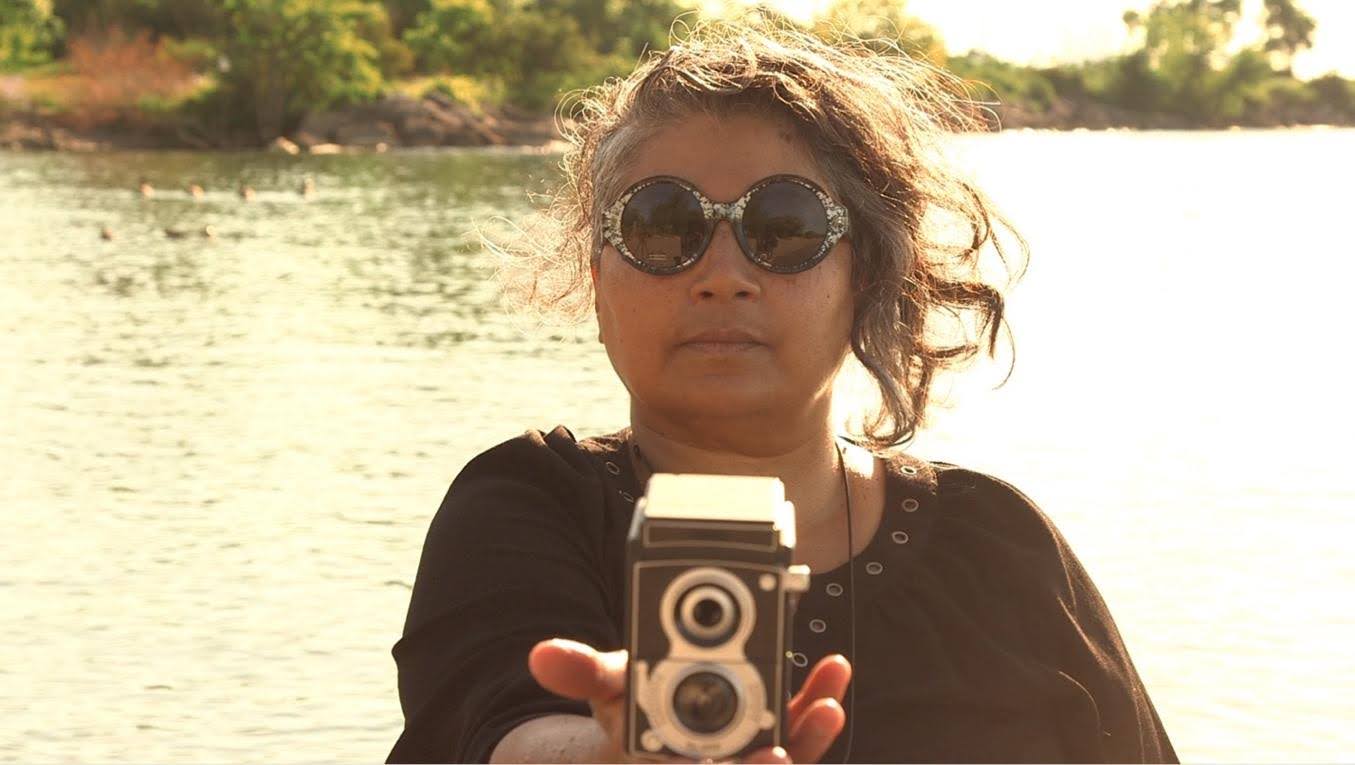
Communications volunteer Ester Bovard draws from The ArQuives audiovisual collections to trace the groundbreaking work of Guyanese-Canadian filmmaker Michelle Mohabeer, whose films challenge dominant narratives and reclaim space for queer, feminist, and diasporic identities.
The ArQuives’ audiovisual collections are rich with hidden gems hard to find anywhere else – works that challenge dominant narratives and preserve voices too often pushed to the margins. Among those treasures are the powerful and thought-provoking films of Guyanese-Canadian filmmaker Michelle Mohabeer. An accomplished academic and media artist, Mohabeer has devoted her career to exploring the complexities of cultural identity, gender, and sexuality through an intersectional lens. This article takes a closer look at her evolution as an artist, examining how her films reclaim space in the archive and redefine the art of queer feminist representation.
Born in Guyana in 1961, Mohabeer immigrated to Toronto with her family in 1973, only to find a country far more conservative and intolerant than the one we know today. To cope with the “culture shock and isolation [of] living in Canadian society” (South Asian Visual Arts Centre), Mohabeer immersed herself in the arts, exploring the work of gay and lesbian artists and sowing the seeds of her future filmmaking practice. Having nurtured her love of film throughout her adolescence, Mohabeer was inspired to pursue a film degree at Carleton University. The only woman of colour in her program – an environment she found to be deeply racist, sexist, and homophobic – she struggled to find artistic inspiration and community until her return to Toronto in the late eighties. Finding a greater sense of belonging and acceptance among the burgeoning communities of artists and queer women of colour in the city at that time, her experimental filmmaking practice began to evolve in exciting new ways.
Like many Canadian feminist filmmakers of that era, Mohabeer’s earliest public work was produced for Studio D – the National Film Board of Canada’s (NFB) prolific feminist filmmaking studio. Included in their Five Feminist Minutes series, Exposure (1990) serves as not only a powerful piece of documentary filmmaking but a remarkable archival document in and of itself. Featuring fascinating archival photographs illuminating the lives of lesbians of colour in Canada in the seventies and eighties, Exposure was one of the NFB’s first lesbian themed films, paving the way for later projects such as Aerlynn Weissman and Lynne Fernie’s Forbidden Love: The Unashamed Stories of Lesbian Lives. Structuring the film around a dialogue between two queer women from very different cultural backgrounds – one Afro-Caribbean and one Japanese-Canadian – Mohabeer was actively exploring the politics of intersectional identities long before these topics entered the mainstream.

“Sistren Song” Source: Screenshot from Exposure.

Leleti Tamu and Mona Oikawa. Source: Screenshot from Exposure.
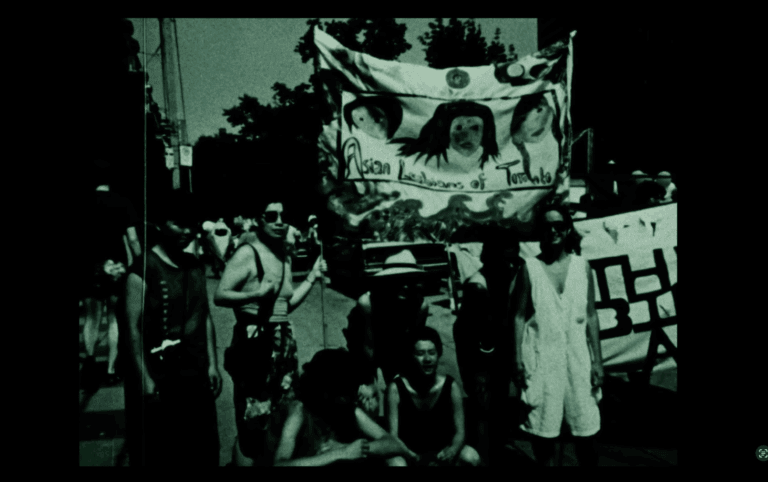
“Asian Lesbians of Toronto” Source: Screenshot from Exposure.
Emboldened by her work on Exposure, Mohabeer went on to create the ambitious experimental feature Coconut/Cane & Cutlass (1994). Shot largely in her native Guyana, Coconut/Cane & Cutlass is at once her best-known film and her most personal. Layering documentary footage with archival imagery, poetry, and performance art, Mohabeer’s film loosely dissects the complexity of her intersecting identities as she attempts to understand how she fits (or no longer fits) into Guyanese society. Exploring how the legacy of colonialism and the trauma of migration and displacement interact with queer and feminist identities, Coconut/Cane & Cutlass takes the viewer on a rich and dreamlike journey alongside Mohabeer as she reckons with the many layers of her personal identity.

Michelle Mohabeer. Source: Screenshot from Coconut/Cane & Cutlass.

Indo-Guyanese poet Mahadai Das. Source: Screenshot from Coconut/Cane & Cutlass.

Choreographer/Dancer Florette Fernando. Source: Screenshot from Coconut/Cane & Cutlass.
Following the completion of Coconut/Cane & Cutlass, Mohabeer delved even deeper into her filmmaking practice, completing an MFA in film production at York University and a PhD in Communication and Culture at the University of Toronto. Now a professor at the School of Gender, Sexuality & Women’s Studies at York, she has continued to examine the complexities of intersectional identity through her filmmaking on projects such as Two/Doh (1996), Child-Play (1997), Tracing Soul (2000), Echoes (2003), and Blu in You (2008) – all preserved in the audiovisual collections of The ArQuives.
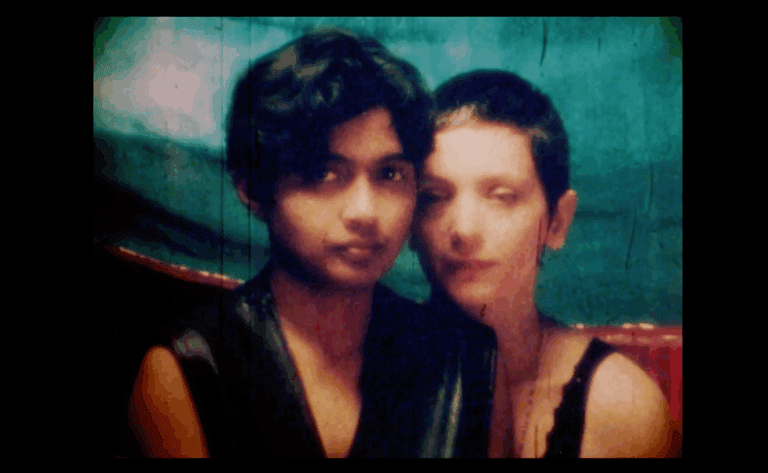
Sharmini Fernando and Alina Martiros. Source: Screenshot from Two/Doh.

Stills from Child-Play. Source: lgbtqdigitalcollaboratory.org/some-thoughts-on-michelle-mohabeers-child-play-1997

Nalo Hopkinson. Source: Screenshot from Blu in You.
In her most recent work, Queer Coolie-tudes (2019) – something of a spiritual successor to Coconut/Cane & Cutlass – Mohabeer questions the ways that the Indo-Caribbean diaspora has largely been left out of the narrative of queer history in Canada. Through a series of revealing interviews, she shines a light on the rich diversity of queer experience not only in Canada, but in the Indo-Caribbean community itself. While her interviewees hail from a variety of professional and cultural backgrounds, many express similar concerns. Discussing the importance of archival representation in particular, they express their frustration in feeling their memories and histories drowned out by voices representing a “predominantly white queer Canadian past” (Amar Wahab qtd. in Queer Coolie-tudes).

Source: Screenshot from Queer Coolie-tudes.
While the problem of underrepresentation is one that many in the archival field are actively attempting to address, Mohabeer has consistently sought to amplify marginalized voices in the archive, working tirelessly to create pieces that better reflect the true diversity of queer experience in this country. Indeed, Mohabeer’s impressive body of work – from Exposure to Coconut/Cane & Cutlass to Queer Coolie-tudes – stands as an invaluable addition to the queer history books not only in Canada, but across the globe.
Citations:
Atluri, Tara. “Putting the ‘Cool’ in Coolie: Disidentification, desire and dissent in the work of filmmaker Michelle Mohabeer.” Caribbean Review of Gender Studies 3 (2009): 1-24.
Mohabeer, Michelle. “About.” https://michellemohabeer.com/about.
“Michelle Mohabeer.” Wikipedia, https://en.wikipedia.org/wiki/Michelle_Mohabeer.
Redding, Judith M. and Victoria A. Browning. “Michelle Mohabeer: The Politics of Identity, Part Two.” Film Fatales: Independent Women Directors. Seal Press, 1997.
South Asian Visual Arts Centre (SAVAC). “Oral History Interview with Michelle Mohabeer.” The ArQuives Digital Exhibitions, https://digitalexhibitions.arquives.ca/items/show/823
Watch list:
Exposure (Michelle Mohabeer, 1990)
Coconut/Cane & Cutlass (Michelle Mohabeer, 1994)
Two/Doh (Michelle Mohabeer, 1996)
Child-Play (Michelle Mohabeer, 1997)
Tracing Soul (Michelle Mohabeer, 2000)
Echoes (Michelle Mohabeer, 2003)
Blu in You (Michelle Mohabeer, 2008)
Queer Coolie-tudes (Michelle Mohabeer, 2019)
Author bio:
Ester Bovard is an archival film scholar and writer based in Toronto. A graduate of the MA programme in Preservation & Presentation of the Moving Image at the University of Amsterdam, she has collaborated on projects with Arsenal Institute for Film and Video Art, UMAM Documentation & Research, and the Netherlands Institute for Sound & Vision.