

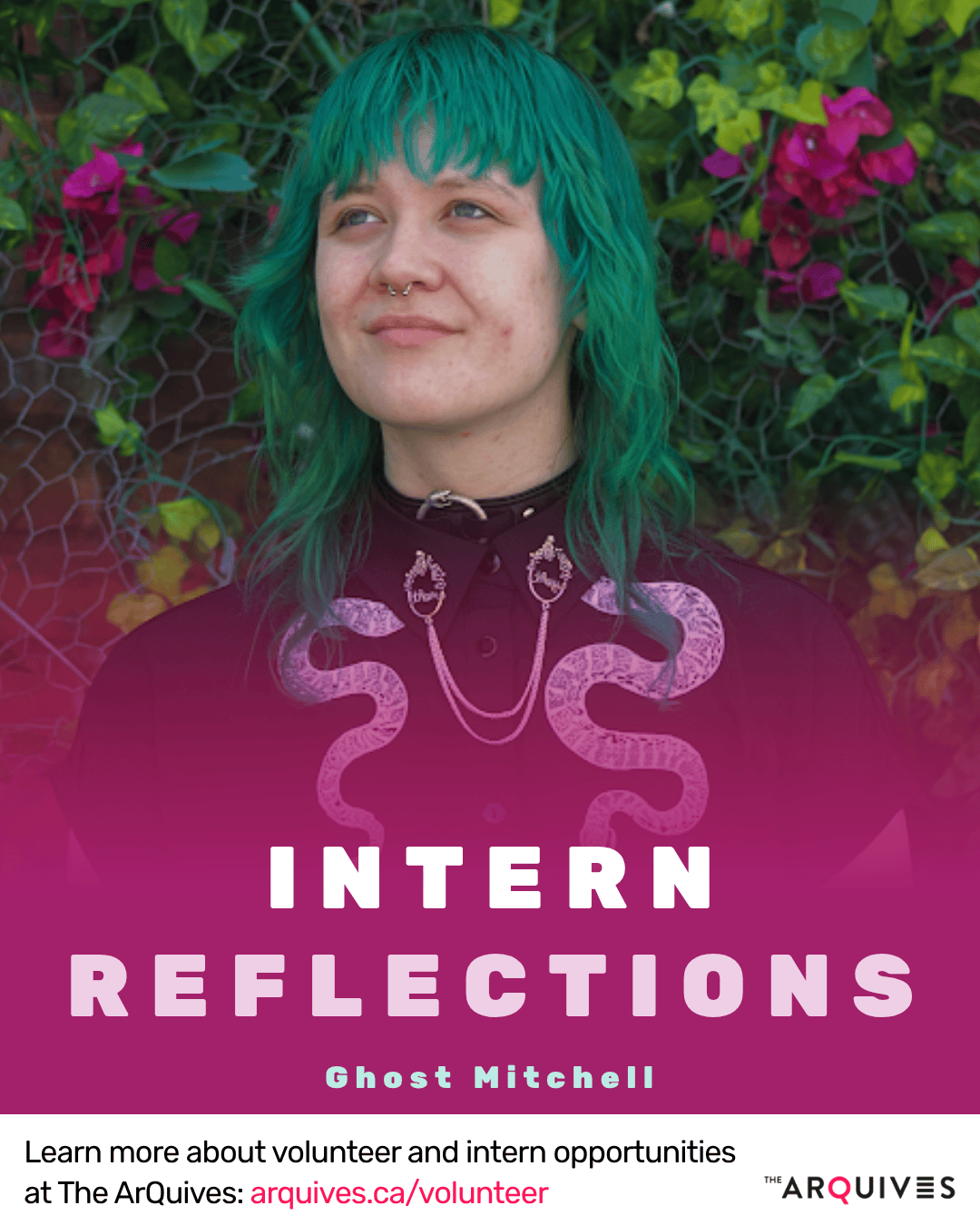
My name is Ghost Mitchell, and I am a nonbinary undergraduate student in my third year of university courses at The University of Toronto. I am a double major in both Drama and Sexual Diversity Studies. I have always wanted to learn more about queer and trans history, as they were subjects never previously covered in my formal education. I discovered The ArQuives in first year, during a class where we toured the city to see the places in which queer people have and had claimed space. I was extremely interested in The ArQuives, and while I desired to explore it, I had never considered that I might someday get the privilege to volunteer there. This year was that “someday”.
I found The ArQuives to be an incredibly meaningful, accepting, and fulfilling space. I think community archives are crucial to documenting our queer histories. What drew me most to this project was the humanity and life that exists within every paper and document. I was enamoured with the connections I made and saw others make within the space. This project deepened my knowledge of queer and trans histories and let me feel warm and welcomed into a place of documenting our collective histories.
As the largest independent LGBTQ+ archive in the world, The ArQuives often receives gifts such as love letters, zines, flyers for fundraising dances, buttons, film, photos, art and much more. To help manage the process of this gift-giving, the ArQuives uses a document called a “Deed of Gift Agreement.” The “Deed of Gift Agreement” is a document that details the transfer of ownership of a gift from gift-giver to The ArQuives. Requiring a signature, verification of ownership, outlining copyright, and a detailing of access restrictions, The ArQuives “Deed of Gift Agreement” comprehensively covers all a gift-giver may wonder about or want to specify.
In my “Engaging Our Communities” class in Sexual Diversity Studies this year, we had the incredible opportunity of choosing a queer organization within the city to volunteer with. We had an array of choices, but the only one I had heard of, the one I had desperately wanted to be a part of since the moment I heard of it, was The ArQuives. Due to my interest in the history and the humanity held within the deeds of gifts themselves, I felt most drawn to this project. I wanted to learn about the queer people before me. I hoped to build organizational skills and see if deskwork would be something that would fulfill me, career or volunteer wise, in the future. I felt driven towards archives in general due to discussions in my “Methods in Queer and Trans Studies” class and my “Queer of Colour Critique” class covering it, as well as our discussions in my “Engaging Our Communities” class. I wanted to build inter-personal workplace skills and engage more deeply with being part of a team.
The “Deed of Gift Agreement” project is an important part of how The ArQuives functions, as citing the original gift-givers lets them have consent-based control over how their gifts are used by The ArQuives and demonstrates the respect and thanks we hold for their gifts.
The ArQuives acquisition policy is how they determine which donations are accepted, and the limitations surrounding what gifts they accept. The ArQuives has implemented policies to represent the queer community more accurately, by seeking unheard narratives and de-centering those already overrepresented in their collections. The ArQuives has the acquisition policy to continue their mandate and mission, specify what can and cannot be accepted, certify the safety of the archivists, and to detail how they acquire and maintain their collections. The ArQuives are managed and records maintained by The ArQuives workers themselves.
In the “Deed of Gift Agreement” project, my work was to select an archival box, and double check the work of the previous intern who had digitized the materials. If there were any materials that hadn’t been scanned, or a material that required a high-quality scanner, I would scan the material in and mark which document required the high-quality scanner. My teammates and I shared a spreadsheet to document our work, marking any issues or needs within the deeds of gifts. I found practically no deeds of gifts in my boxes as I specifically had chosen to work with some of the archive’s oldest materials, before the deed of gift agreement as it exists today was even established. I found the occasional original predecessor to the deed of gift agreement, yet most were almost entirely blank aside from the full name of the gift-giver. These archaic predecessors were much simpler than today’s deeds, missing the thoroughness The ArQuives achieves today. I enjoyed this jump back in time though, as many archival folders I examined contained handwritten notes and letters denoting ownership, use, and who the material was for at “The Body Politic”, the queer magazine —which, as you may know—was the birthplace of The ArQuives, originating out of a single file cabinet in their office.
Working with these older documents demonstrated to me the deep necessity for the development of the “Deed of Gift Agreement”, as many gift-givers had no way to specify restrictions around their gifts. Without signatures or ways to contact the original owner, oftentimes gifts cannot be used for displays or education.
This internship was essential to my education as I was able to learn what working in a professional archiving environment can look like. I have not had much experience in professional workspaces (aside from film sets I have worked on) and found it incredibly interesting building this new set of skills. I developed my resume writing and interview skills through the process of receiving this internship. The skills I believe are most valuable and transferrable that I learned were communication and teamworking skills, organizational skills, and digital literacy. I found that while I have heard desk jobs be called monotonous throughout my life, I found the repetition within my position surprisingly both fulfilling and calming. I found joy in being able to accomplish something well, and it was a very low stress and quiet environment.
Expanding on building skills through this position, I found communication to be a crucial step of the job. I saw this as one of the most transferable skills I built as many jobs desire applicants who are clear communicators and well-versed in teamwork. I was confident in my communication skills but found that I had to build a lot of courage to approach my team members and supervisors about technological issues I personally could not figure out. I built a lot of digital literacy through this job after I was able to ask for help, as everyone supported me in my learning. Their kindness inspired me to aim for similarly compassionate teammates and supervisors in the future. I am more familiar with spreadsheets, operating printers, organizing files and was reminded of the calm I find in my body when in a well-organized space. I found the organizational systems in The ArQuives very functional while allowing for the “messiness” of queering organizational borders. I was reminded of Manalansan’s piece: The “stuff” of archives: The “stuff” of archives: Mess, Migration, and Queer Lives.
Overall, I learned the deep importance of queer values of citation and respecting ownership restrictions, as every document I touched felt so personal and deserved recognition and respect. Working with the oldest materials I could find at The ArQuives demonstrated to me why the “Deed of Gift Agreement” is necessary and a form of reciprocity of care. I will hold the time I spent at The ArQuives deep in my heart, as with all I learned from it.
Author: Ghost Mitchell