


From research, to movies, exhibitions, to workshops, a new generation of public programming is finding different ways to reimagine who uses The ArQuives and what a resource can be.
There is a myth that archives are just for researchers and “public access” refers to an exclusive club of people who can navigate its system. That is not meant for the community reflected in the collection. However, this myth comes from facts, based on the history of colonial and government collecting institutions that, whether deliberate or accidental, participate in the symbolic erasure of communities within archives. Erasure is systemic and organized, hiding behind traditional archival practices or paradigms, but it is not simply just the destruction of materials; it is also the inaccessibility, or limiting access to materials, and performative outreach that does not intend to cultivate community relationships or accountability with those most at risk of being erased.
These institutions are slowly changing their practices, especially around making materials accessible to the public as a resource. The ArQuives isn’t excluded from these historical inequities and erasure. However, one thing that hasn’t changed since 1973 is the idea that The ArQuives can be more than a space providing public access to materials. Archives can be a real community resource, that is active, involved, and makes available resource material relevant to all aspects of 2SLGBTQIA+ history – keeping history, and the collections alive!
Another belief that hasn’t changed since 1973 is the idea that a ‘resource’ can be as diverse as protective, meaning we can responsibly and ethically protect and preserve holdings while still being open to evolving the utilization of materials. This belief, as an embodied practice, has evolved. How we approach questions like the usability of materials, what public access means, starts with community-centred care and accountability as an act of reciprocity. It’s not a perfect formula, but for me, reciprocal workshops mean producing alternative programming that shares resources and skills to serve community needs, whether or not this produces tangible archival records or donations.

Pussy Power Patch
Public programming as a resource is especially untethered from formal approaches of research requests and reading rooms. In fact, I would argue, despite workshops being organized and often pre-planned with a theme and selected materials, there can be something radically inclusive and unruly about them. What I mean by unruly and untethered is that workshops, while structured, are not rigid; there is push and pull between control and release. For me, as I plan workshops, I find this push and pull effect creates a certain level of ease when I pitch sometimes absurd ideas to archivists, librarians, and collection specialists.
So, if the next addition to ‘resource’ is something untethered and a little unruly, how can we create a workshop that, in one afternoon, can help build community and trust, ethically share parts of the collection, and find a rhythm between control and getting lost in creativity? Maybe one answer is the most recent Stitch n’ Bitch held at The ArQuives?
Workshops are an open invitation to the community to enter our space, experience the collection, and learn what we do. What’s more, they offer an opportunity to make connections with one another and hopefully start to connect with where you might fit. The best part about workshops is seeing that “Aha!” moment, that they are also part of the mandate and vision and are part of the original concern presented in The Body Politic in 1973, which was to gather and make available resource material relevant to all aspects of the 2SLGBTQIA+ community.
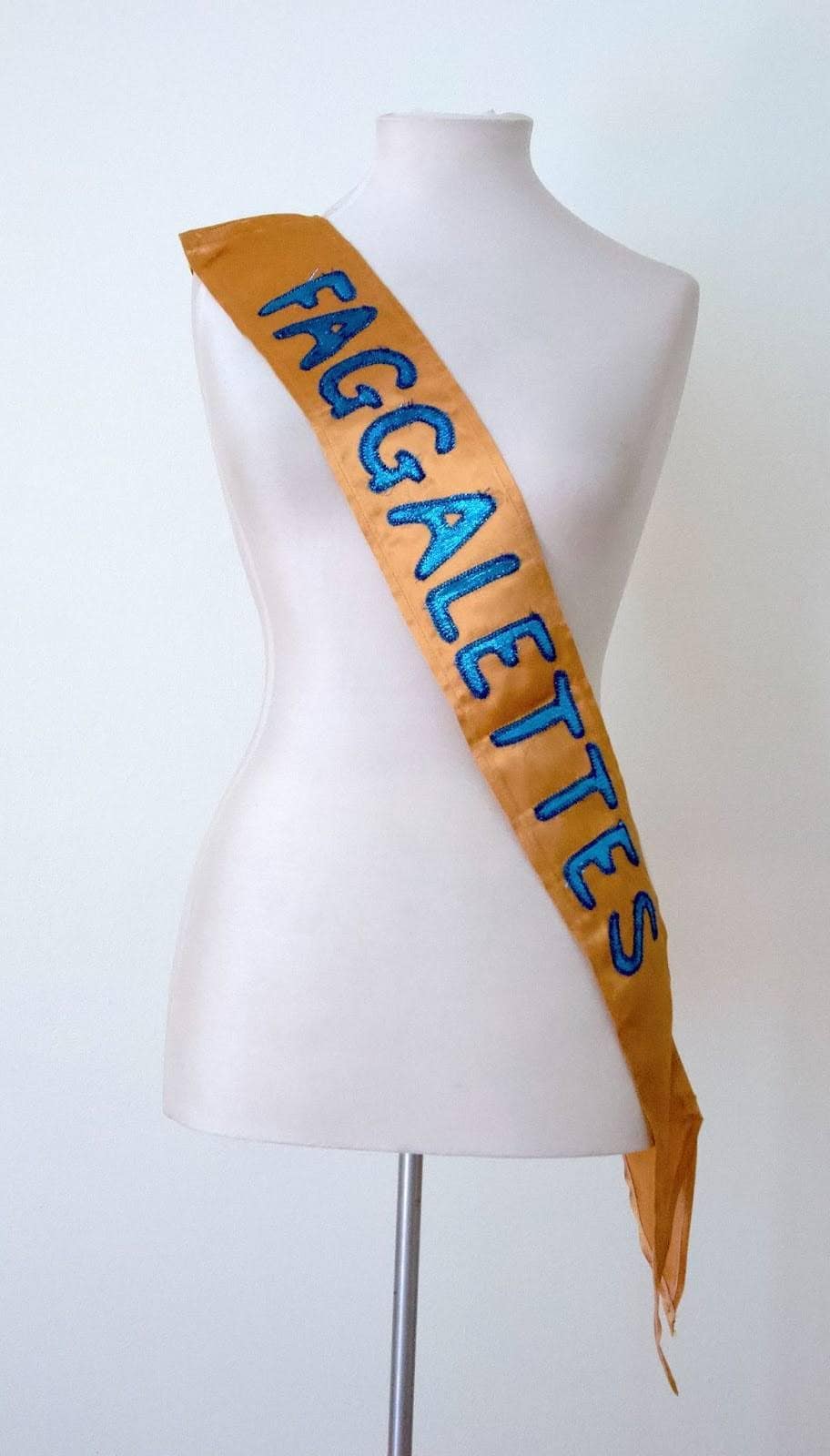
The Fabulous Fagalettes Sash. Credit: Alexis Green.
Unruly workshops like a Stitch n’ Bitch can feel like an absurd idea – if the focus is on the collection, why would we want to invite people to a workshop that asks you to bring your own project to work on? The Button and Zine workshops provide duplicate materials to re-fashion into new creations but the Stitch n’ Bitch relies on you to come with not just a skill but an in-progress project to boot! Luckily, like me, our Collections Specialist, Patrick Taylor, didn’t spend too much time stressing about this question when I pitched the idea.
Patrick primarily focuses on artwork and artifacts, and over the course of the last year, I’ve gotten the privilege of looking over his shoulder to see and learn about all the costumes, clothes, patches, and general textiles that have been entrusted to us to protect and care for. There is something so inclusive and natural about these conversations – maybe it’s because of Patrick’s love for each artifact, maybe it’s his excitement to learn more information so we can share with our community, or maybe it’s just his easy personality? It is definitely a mix of all three, which is the perfect recipe for a Stitch n’ Bitch that can bridge the gap between our own creations and the collection.
The ‘Stitch’ is only half the story – there is also the ‘Bitch’, which is the opportunity to gab with one another, and gab we did! I think gab is a great description here because it wasn’t a formal or structured presentation just focusing on dates; by gabbing with Patrick (which is a rather unruly approach to a presentation) meant that each artifact presented could go beyond the facts – each artifact was alive, it moved off the shelf, and we could talk about how things have changed, stayed the same, how the artifact was made, and what approach we would take to try and make it today.
The push and pull between control and release meant artifacts could be released – they were placed on a table, which folks could get up and look at throughout the workshop. The control side of things was that we could choose materials, taking into account things like interest and originality, and we could ensure they were protected by asking participants not to handle them on their own. We found the rhythm between control and creativity because in that room, there was a connection between an absurd pitch, the responsibility of preserving our stories, and mutual trust.
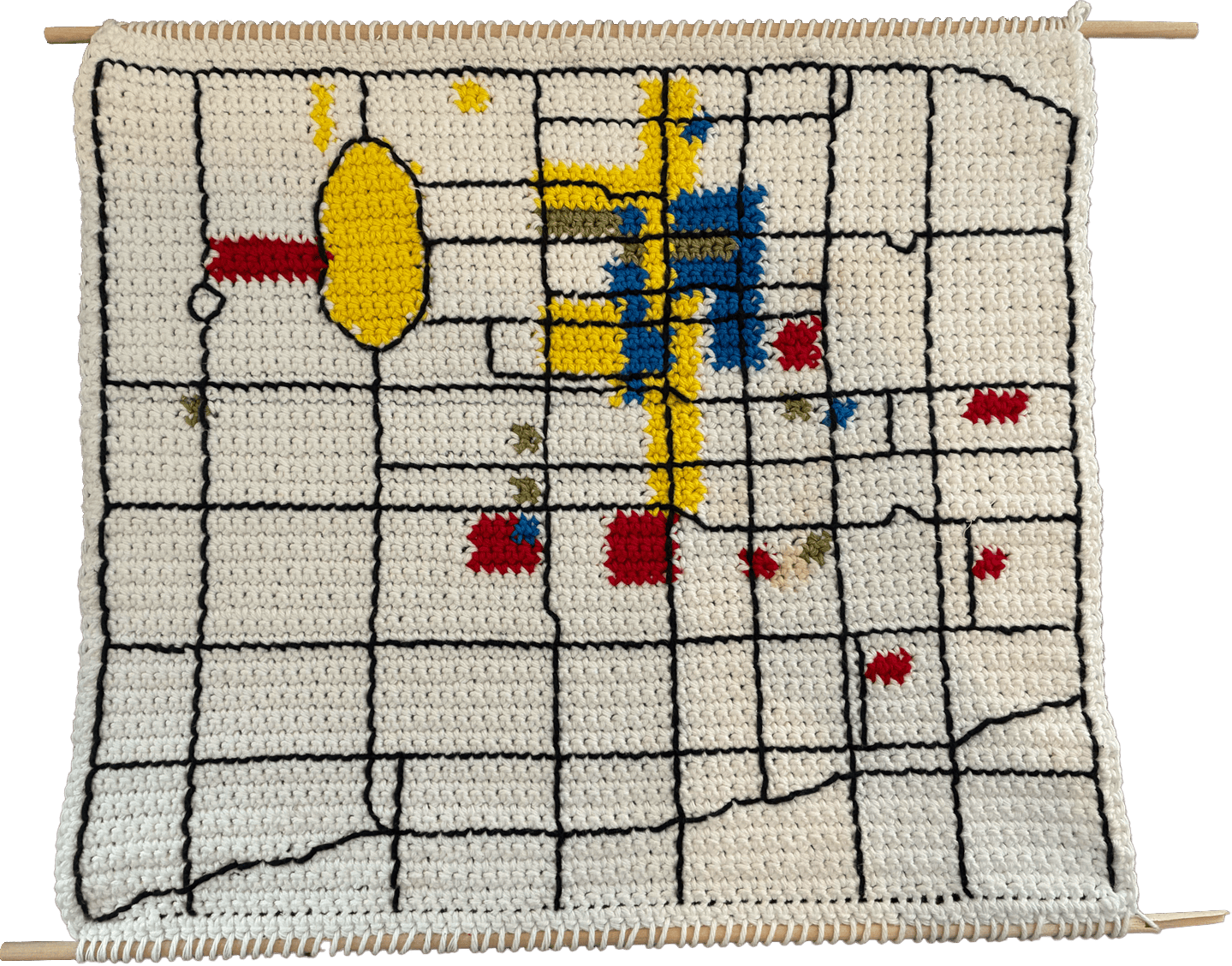
Crochet Map of Toronto’s Gay Village. Artist: Angelica Buha. Photo: Patrick Taylor
Artifacts we selected included custom-made drag heels created by Canadian playwright and Drag Queen John Herbert, which were hand-carved and painted from a pair of men’s boots, handmade ‘Barbie’ dolls that look like icon Michelle Ross, right down to miniature versions of some of her most recognizable gowns, and needlepoint made by artist Enoch Gray. A crocheted map, donated and created recently by Angelica Buha, depicting self-determined queer spaces of Toronto from the 1960s to the 1990s, based on research she conducted here at The ArQuives. We had a lot of conversations about the complex relationship between historical craft techniques and queer identities, which I don’t think could have happened if we had taken a formal presentation approach.
The “Aha!” moment happened in February; it was the most “Aha!” moment I ever had in a workshop, and while all my workshops are a labour of love, which I look forward to – I think this may have been the most unruly and untethered workshop I pitched, it was also the most rewarding one so far.
I look forward to future workshops. This is an open invitation to join, be unruly, unpolished, and connect beyond the reading room. If it sells out, it’ll just be another excuse to do another soon!
Jade Nelson is an arts programmer focusing on experimentation and low-barrier community access to archives beyond the reading room. They hold a Master’s in Gender, Feminist, and Women’s Studies from York University and a BA (Hons) in History and Sexual Diversity Studies from the University of Toronto. Their research focuses on the translation and development of identities, knowledge, memories, and publics through fashion, dress and style.
Patrick Taylor holds a graduate degree in Fashion from Toronto Metropolitan University, and an undergraduate degree in Art History and Sociology from the University of Victoria. His graduate research focused on the embodied nature of dress within archives, and the biographical narratives of historic wardrobes. With a strong interest in material culture, his research continues to focus on the complex relationship between dress, gender and identity.
Header image: Who Uses the Archives? Issue #9. 470-02-1991_Gay_Archivist.