

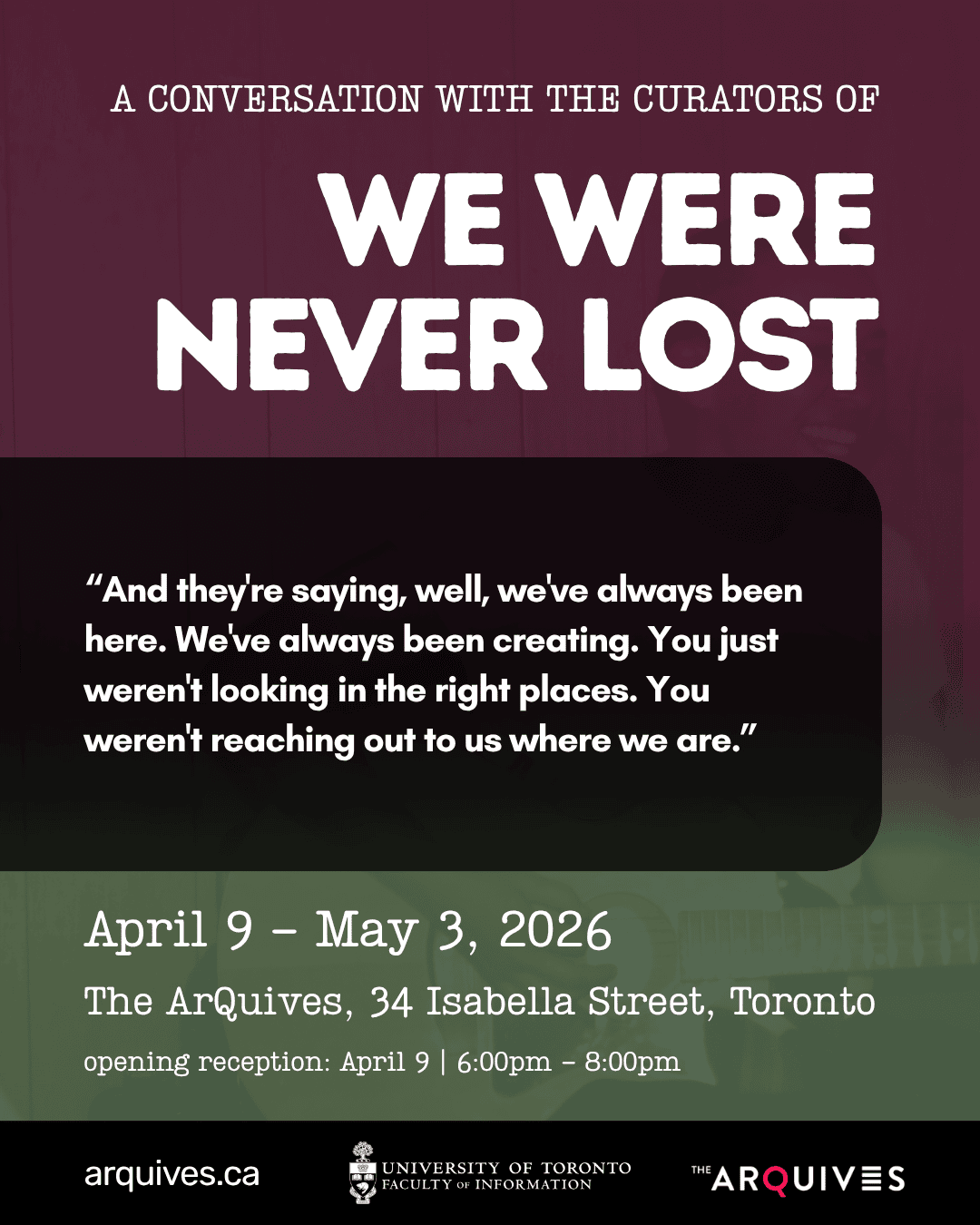
Developed as part of the Master of Museum Studies Capstone Projects course at the University of Toronto, the upcoming exhibition We Were Never Lost highlights the creative and community-building practices of queer women of colour in Toronto. Ahead of the opening on April 9th, Communications volunteer Ester Bovard sat down for a chat with curators Abla Touglo Midodji, Emily Coneybeare, Cameron Findlay, and Zhikall Kakei.
Ester Bovard, The ArQuives (EB): How did the concept for the exhibition come about? What drew you to this subject?
Abla Touglo Midodji (ATM): I was introduced to Sister Vision Press through a course that I took at U of T last year. It was a Black feminist histories course. That was the first time I got a chance to read through some Sister Vision Press texts. Then, at the start of this school year it was actually the 40th anniversary of Sister Vision Press. I had a chance to go to the symposium that was held at McMaster University and speak to some folks who were involved in Sister Vision Press. One of the co-founders and her daughter, and some other folks who were involved in the organization. From there, we originally focused upon Sister Vision, but then through more research and digging further into the repositories available at The ArQuives, we expanded to some of the other organizations that were up and around during that time. There’s a lot of interconnection between those organizations, so it made sense to expand it that way.
EB: Can you talk a bit about the process of working with the staff at The ArQuives and how you started to further develop your concept?
ATM: In September, we had a chance to meet Raegan [Swanson, Executive Director of The ArQuives] for the first time, and establish the Capstone team. From there, we had a chance to really work closely with Daniel [Payne], first and foremost, as the Reference Archivist, and he helped us in this paper trail of finding these other organizations that existed. And then in due time, we worked with [Collections Specialist] Patrick Taylor on ensuring that the display of objects will be handled correctly. We’ve also worked with Jade [Nelson, Volunteer and Community Outreach Coordinator], who’s helping us out on the final stages of establishing the exhibition. It’s been a bit of outside research and in-house research. When we’re in-house, it’s mostly Daniel that we’ve engaged with.
Emily Coneybeare (EC): Daniel’s been so helpful. Even from the first visit, he was bringing us to different materials. So that provided us gateways to different things that we hadn’t thought about before in the same kind of realm. It’s been very fruitful.
EB: Was there anything that surprised you in digging through The ArQuives’ collections? Was there anything in particular that jumped out at you? Any records or artifacts that you were excited to find or that were beyond the scope of what you might have expected to find?
EC: I don’t know that we had expectations per se, of what we were going to find, mostly because we haven’t done an archival exhibition before. So, this is a new experience for all of us. I think what stuck out to me is that everything kind of clicked so perfectly. Things were so interconnected and even things that we had taken a look at really early in the project … way later, we’re like, oh my gosh, there’s a connection with that thing from way before. And everything’s aligning so well.
Cameron Findlay (CF): Yeah, I think for me, seeing the same names pop up across these organizations has been really interesting. You’ll open up an issue of Fireweed, and it’ll have selections from people that were a part of Sister Vision, and they published books and anthologies, and then they also led a workshop at Camp SIS. You see the same names popping up in a lot of places.
EB: That’s really interesting. I noticed that as well, just how many names pop up in different ways, and also how varied their work seems to be. From music to filmmaking to writing, they seem to dip their toe into a lot of areas and really support each other in their various projects. Is that something you found as well?
ATM: Yeah, there was a great network of support amongst the organizations highlighted. Even through our consultation interviews with community members who were involved in one way or another, they all made extra emphasis on: Yes, we may have explicitly been under X collective, but best believe we were also helping out Y collective. We were doing childcare for this collective so the women could go out and organize the way that they needed to. We made sure that community and support was at the basis of our organizing practices.
EB: One thing that I found interesting was the title that you chose for the exhibition – We Were Never Lost. Can you tell us a bit more about the meaning of that phrase and why you chose to highlight it?
CF: Originally, it comes from the editorial title for the Women of Colour issue of Fireweed. We really wanted to highlight that issue because it was the first periodical dedicated to solely women of colour. The guest collective that was in charge of putting the pieces together – editing, reaching out to writers and contributors – really fought to have that issue published. There [had been] some conflict between the core collective of Fireweed and the outside guest collective made up of women of colour. They had approached Fireweed a few years earlier and asked them to put together a women of colour issue. At the time, they chose not to. A few years later, the core collective came back to Makeda Silvera, Stephanie Martin, and a few other members of the women of colour collective and said Hey, do you want to do this? And they were asking, Well, why now? Is this just an act of tokenism? Why did you say no before and are saying yes now?
They wrote about these kinds of struggles in that editorial, and titled it We Were Never Lost, because they cited that a lot of these very white-centric collectives said that they had trouble finding women of colour to contribute to our periodical or our newspaper or our book. And they’re saying, well, we’ve always been here. We’ve always been creating. You just weren’t looking in the right places. You weren’t reaching out to us where we are. So, we thought that that was a good all-encompassing phrase. Maybe not everybody knows about these collectives that were doing this really vital work in Toronto during this time period but they were always there and they were always working together. Their legacy is still felt today and people still have really fond memories of the work that they did, and that is still being felt in the work that people continue to do today.
EB: On that note, what would you point to as the central legacy that is carrying forward from the work of these groups? What message do you hope that people take away from this exhibition?
EC: I think we hope that they’ll feel inspired and empowered to create community and organize collectively in their own lives. To see the power of creative activism and take that and make something themselves, carrying this legacy forward.
ATM: On a similar note, I think I want folks to feel the power of having a creative practice. And how much more impactful it becomes when community forms through said practice.
This interview has been edited for length and clarity.
Interviewer bio: Ester Bovard is an archival film scholar and writer based in Toronto. A graduate of the MA programme in Preservation & Presentation of the Moving Image at the University of Amsterdam, she has collaborated on projects with Arsenal Institute for Film and Video Art, UMAM Documentation & Research, and the Netherlands Institute for Sound & Vision.